
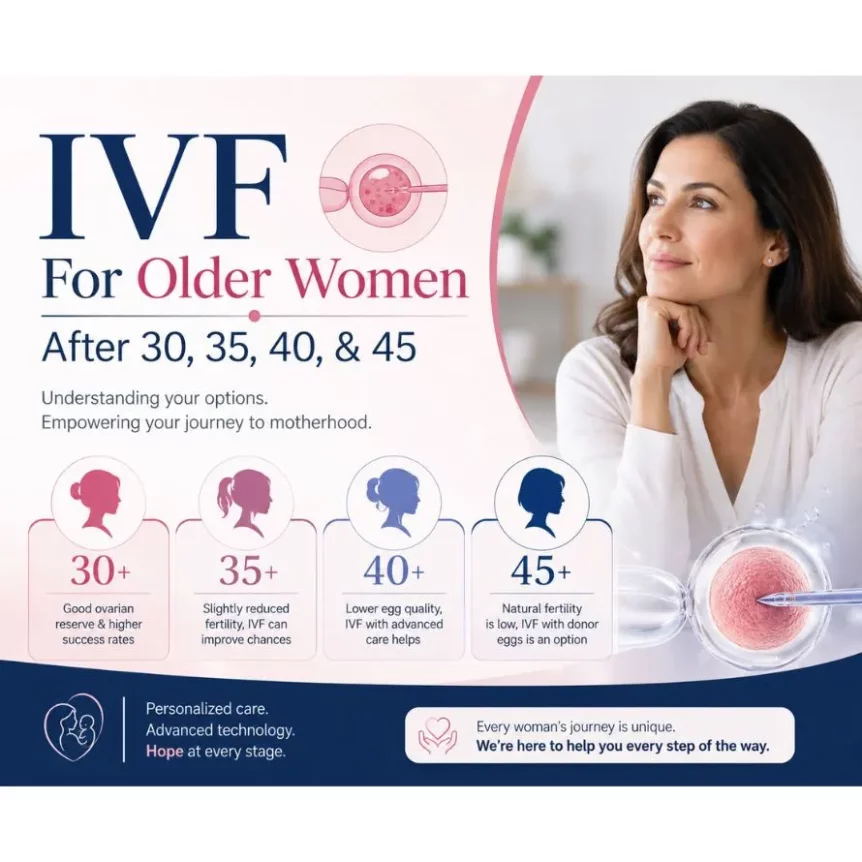
Deciding to start or grow your family after age 30 can bring up complex feelings. You might find yourself thinking more about your biological clock than you did in your twenties. While natural fertility begins to drop as you get older, science has provided ways to help.
IVF For Older Women After 30, 35, 40, & 45
| Age Group | Fertility Outlook | IVF Considerations | Recommended Action |
|---|---|---|---|
| After 30 | Good ovarian reserve and egg quality in most women. | Higher IVF success rates compared to older age groups. | Consider fertility assessment if trying to conceive for 12+ months. |
| After 35 | Gradual decline in egg quantity and quality. | IVF can improve chances of pregnancy with timely treatment. | Seek fertility evaluation after 6 months of trying. |
| After 40 | Noticeable decline in fertility and increased miscarriage risk. | IVF with advanced reproductive techniques may be recommended. | Consult a fertility specialist as early as possible. |
| After 45 | Natural conception becomes significantly more challenging. | Donor egg IVF is often considered for higher success rates. | Discuss personalized fertility treatment options with experts. |
Many people turn to IVF for older women to bridge the gap between their family goals and their biological timeline. Success is not guaranteed, but understanding the process helps you make informed choices about your future.
IVF Success Rates for Older Women: What to Expect
It helps to start with a clear picture of how age affects your body. Your chances of getting pregnant with IVF depend heavily on the age at which you start the process. This does not mean it is impossible, but it does mean you should look at the data with a clear head.
Understanding Age-Related Fertility Decline
Women are born with a set number of eggs. As time passes, that number decreases. It is not just about the count, though. The quality of those eggs also changes. By the time a woman hits her mid-thirties, the risk of chromosomal abnormalities in eggs starts to rise. These abnormalities make it harder for an embryo to implant or grow to full term. This is why many doctors suggest checking your ovarian reserve early if you are over 30 and trying to conceive.
IVF Success Rates by Age Bracket
Statistics from the American Society for Reproductive Medicine (ASRM) and the Centers for Disease Control and Prevention (CDC) show clear trends. For women under 35, the chance of a live birth per IVF cycle is typically higher. As women enter their late 30s, these rates begin to shift downward.
Once a woman reaches her 40s, the statistics change again. Data shows that live birth rates per cycle for women age 40 to 42 are often below 15-20%. For women 45 and older, the success rate using their own eggs is very low, often less than 5%. These numbers represent averages, and your specific clinic or health profile might show different results. Always ask your clinic for their specific data regarding patients in your age bracket.
Factors Influencing IVF Success Beyond Age
Age is the most significant factor, but it is not the only one. Your overall health matters just as much as your age. Sperm quality from your partner or a donor plays a huge role in embryo health. Uterine health is also critical, as the lining needs to be receptive for the embryo to stick. Finally, the specific protocol your doctor chooses can affect how your ovaries respond to the medications.
Preparing for IVF: Key Steps for Women Over 30
Success with IVF often starts long before the actual procedure. Preparation is about giving your body the best possible environment for success. When you use IVF for older women, your doctor will likely want a very detailed picture of your health.
Comprehensive Fertility Evaluation
You need to know where you stand before you begin. Your doctor will order a series of tests to check your hormone levels. This usually includes testing for AMH (Anti-Müllerian Hormone), which helps estimate your egg supply. They will also look at your FSH (Follicle Stimulating Hormone) and estradiol levels.
A pelvic ultrasound is standard to check for any fibroids or polyps in the uterus. If you have a partner, a semen analysis is essential, as male factor infertility is common. These tests help your doctor build a plan that fits your specific needs rather than a one-size-fits-all approach.
Lifestyle Changes for Better Results
Small habits can add up over time. If you smoke, quitting is the most important step, as it directly damages egg quality. Reducing alcohol intake and cutting back on caffeine are also standard recommendations for most fertility patients.
Focus on a balanced diet rich in vegetables, healthy fats, and lean proteins. Some studies suggest that supplements like CoQ10 might help improve egg energy in older patients. Always clear any supplements with your doctor before adding them to your routine. Managing stress is also vital, as high stress levels can sometimes interfere with hormonal balance.
Understanding IVF Protocols and Medications
There is no single “right” way to do IVF. Your doctor will choose a protocol based on your egg reserve and health history. Common protocols involve injections to stimulate the ovaries to produce multiple eggs at once.
For older patients, doctors might use a “micro-dose flare” protocol or an antagonist protocol to get the best response. The goal is to get a sufficient number of mature eggs while keeping the process safe. You will spend time learning how to mix and inject these medications, which is a major part of the preparation phase.
Advanced IVF Techniques and Technologies for Mature Women
Modern medicine offers several tools to help boost success rates when egg quality is a primary concern. These options are often discussed during your initial consultations.
Preimplantation Genetic Testing (PGT)
PGT-A is a test that screens embryos for chromosomal abnormalities before they are transferred to the uterus. Because the risk of abnormal embryos rises with age, PGT-A can be a game-changer. It helps ensure that only chromosomally normal embryos are used, which lowers the risk of miscarriage and increases the chance of a successful pregnancy. This is a common add-on for women over 35 or 40.
The Role of Donor Eggs
If a woman has diminished ovarian reserve or consistently poor embryo quality, donor eggs might be a path to consider. Using eggs from a younger donor significantly boosts success rates, often reaching levels seen in women under 35. This is a deeply personal decision. Many families find peace and success in this option when their own eggs are not producing viable embryos.
Assisted Hatching and Embryo Glue
These are smaller, specialized lab techniques. Assisted hatching involves making a tiny opening in the outer shell of the embryo to help it “hatch” and implant. Embryo glue is a substance used during the transfer process to help the embryo stick to the uterine lining. While these are not as impactful as PGT-A, your clinic might suggest them if they believe it could help your specific case.
Handling the Emotional and Financial Side
The financial and emotional weight of IVF is real. Many patients find that taking care of their mental health is just as important as taking care of their physical health.
Emotional Well-being and Support
Infertility is stressful. It is normal to feel anxious, sad, or frustrated throughout the process. Find a therapist who specializes in fertility or join a support group. Talking to others who are in the same boat can make you feel less isolated. Build a support network of friends or family who are willing to just listen when things get tough.
Financial Planning for Treatment
IVF is expensive. A single cycle can cost thousands of dollars, not including medication or extra lab tests like PGT. Check if your insurance covers any portion of fertility treatments. If not, look into flexible spending accounts, medical loans, or clinic financing programs. Knowing the full cost upfront helps you plan and avoid surprises later.
Setting Realistic Expectations
It is good to be hopeful, but it is also important to be realistic. Not every cycle works on the first try. You might need to go through multiple cycles to get the result you want. Ask your doctor about success probabilities for your specific situation. Having a plan for “what comes next” can provide a sense of control and reduce anxiety during the waiting periods.
Other Fertility Options and Next Steps
IVF is not the only way to build a family. Sometimes, your clinic might suggest a different path based on your test results or your response to treatment.
Other Assisted Reproductive Technologies
Intrauterine Insemination (IUI) is less invasive and cheaper than IVF. However, it is usually less successful for women over 40 because it does not involve the lab-based screening and selection that IVF provides. Your doctor will tell you if IUI is even worth attempting given your age and ovarian reserve.
When to Look at Alternatives
If multiple cycles of IVF do not result in a pregnancy, it is time to have a serious conversation with your specialist. They may suggest trying a different protocol or switching to donor eggs. If those options are not what you want, you might think about adoption, surrogacy, or living a child-free life. These are big, life-changing decisions that deserve time and care.
Why You Should Consult Specialists
Always rely on a reproductive endocrinologist rather than generic internet advice. These doctors specialize in the complexities of aging and fertility. They have the most accurate data regarding your specific health profile. Regular consultations allow you to adjust your treatment plan based on how your body is responding, which is vital for maximizing your chances.
Making Your Fertility Plan
Your path to parenthood is unique. Understanding the reality of IVF for older women allows you to make decisions that align with your goals and your life. Focus on the facts, stay prepared, and remember that you are doing your best. By staying informed and working closely with your medical team, you can feel confident in whatever path you choose. Prioritize your health and your peace of mind as you move forward.

Devender Gill is an experienced medical blogger & writer on the healthcare researcher with a strong focus on numerous treatments based on the official info from clinics aross network. He Specializes in creating accurate, easy-to-understand medical content covering, medical topics, for instance, IVF, Surrogacy, IUI, ICSI, and other essential ones.
Table of Contents
 WhatsApp us