
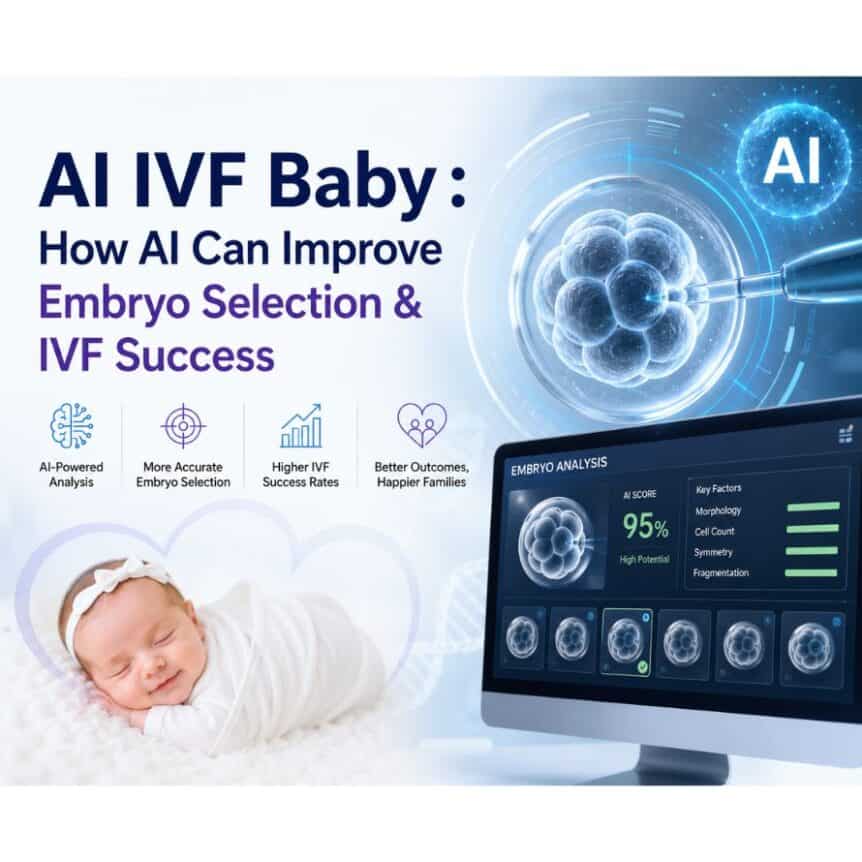
Figure out the advantages or disadvantages of AI IVF baby through these phrases might be assisted in pregnancy. The phrase AI IVF bay describes a baby conception through IVF procedure in the world after AI assisted with one or more procedure tactics.
AI may assess healthy embryo images, support procedure planning, review sperm or healthy egg feature or monitor laboratories conditions. It cannot guarantee pregnancy or become a genetically designed baby. The key question is whether AI can enhance IVF outcomes while protecting safety, consent, privacy, and IVF doctor judgment.
How AI Helps Clinics Assess Embryos
Time-Lapse Review
AI can study embryo development across multiple observations.
Learn more →Pattern Recognition
Development timing and visible changes can be reviewed consistently.
Compare patterns →Clinical Support
Embryologists interpret AI findings alongside clinical information.
Human review →Time-Lapse Imgaing Gives AI A Fuller Record
Why Time-Lapse Imaging Matters
- ✓Embryos may remain in stable culture conditions.
- ✓Cell-division timing can be reviewed across multiple images.
- ✓A development pattern may offer more context than a single snapshot.
Some IVF incubators include cameras that record embryos as they grow. This lets the embryo remain in stable culture conditions instead of being removed for repeated checks.
AI systems can review cell division timing, embryo shape, and changes across many images. A single image shows one moment, while time-lapse footage shows a development pattern. Still, better image analysis does not prove that a tool can predict a live birth.
Embryo Ranking Can Support Tranfer Decisions
| ✦ AI May Analyse | → Clinical Team Also Considers |
|---|---|
| Embryo appearance and growth pattern | Embryo stage and laboratory methods |
| Development timing | Genetic testing when performed |
| Pattern-based ranking | Patient age and medical history |
Machine-learning systems may score embryos based on their appearance and growth pattern. Embryologists can use those scores when deciding which embryos to transfer or freeze.
The final decision also depends on embryo stage, genetic testing when performed, the patient’s age, medical history, and lab methods. AI performance may change between clinics, imaging systems, embryo types, and patient groups. Patients should ask whether the tool is peer-reviewed, independently tested, and used as an aid or as the main ranking system.
What An AI IVF Baby Means For Embryo Selection?
Appearance
Visible embryo features and development.
Implantation
Whether an embryo establishes a pregnancy.
Live Birth
The final outcome influenced by multiple biological factors.
Appearance, Implantation, & Live Birth Are Disparity Outcomes
| Outcome | What It Describes | Important Limitation |
|---|---|---|
| ◉ Appearance | Visible developmental features | A strong-looking embryo may not implant. |
| ✦ Implantation | Establishing a pregnancy | Implantation does not automatically mean live birth. |
| ♥ Live Birth | Final clinical outcome | Depends on many embryo, uterine and biological factors. |
An algorithm may predict embryo appearance, implantation, chromosomal status, or live birth. These outcomes connect to one another, but they are not interchangeable.
An embryo that looks strong may not implant. An embryo with a normal result on a chromosome test may still fail to produce a live birth. Along with this discussion, the main aim of using AI in IVF is just enhance the results with IVF clinic trials outside activities, and proper procedure. and comparisons with skilled embryologists are needed before strong claims can be trusted.
How AI IVF Baby Tools May Guide Treatment Planning
Collect
Clinical information, tests and treatment history.
Analyse
AI identifies patterns within relevant data.
Support
Findings may assist treatment discussion and planning.
Review
Doctors and embryologists retain clinical oversight.
Predictive Models May Guide Ovarian Stimulation
Potential Data Inputs
AI models can combine age, ovarian reserve tests, hormone levels, ultrasound findings, and past treatment response. The goal is to help clinicians choose medication doses and monitoring plans with less trial and error.
This may help avoid an overly weak or strong response. Medical Oversight remains essential because excessive ovarian stimulation can enhance the risk of ovarian hyperstimulation syndrome. A AI compute model cannot replace blood tests, scans, ultrasound or other tests through IVF doctors in India.
Artificial Intelligence Can Assess Sperm & Egg Feature
| 🔬 Area | AI-Supported Visible Assessment | → Clinical Context |
|---|---|---|
| Sperm | Movement, concentration and shape | Appearance does not reveal every fertility factor. |
| Eggs | Maturity and selected structural features | Biological quality remains complex. |
| Embryos | Growth pattern and developmental timing | Scores should support—not replace—expert review. |
In the future it will become a strong way to assess sperm, and egg features. Apart from this, computer vision tools can measure sperm movement, concentration, shape, and other essential visible traits. Similar systems may assess whether eggs are mature, and review certain proper structural features.
These measures can support laboratory decisions, but appearance does not reveal every factor which is linked to fertilization or healthy embryo growth. Sperm, and fertilized eggs biology remains complex, and a normal-looking sample may still lead to poor outcomes.
Procedure Forecasts Are Estimates, Not Promises
An AI-generated percentage can support discussion and expectation-setting, but it cannot guarantee fertilization, implantation, pregnancy or live birth.
Ask → What outcome is being predicted?AI stands for artificial intelligence that may combine IVF clinic estimate fertilization, blastocyst growth, and implantation miscarriage or live birth. Such estimates can assist an IVF doctor discuss opt, and set realistic expectations.
Patients should ask which outcome the model predicts and how accurate it is for people with similar age, diagnosis, and treatment history. They should also ask whether the prediction changes the care plan. A percentage is not a guarantee.
What AI IVF Scores Can & Cannot Tell?
AI Scores May Help
- Consistent review
- Pattern recognition
- Laboratory quality checks
- Decision support
AI Scores Cannot Guarantee
- A future live birth
- Every biological factor
- An embryo’s exact future
- A replacement for clinical judgment
AI May Make Laboratory Reviews More Consistent
Algorithms can measure embryo development using the same rules each time. This may reduce disparities between staff members, and strong support quality checks inside the best IVF laboratory.
Standard measurements cannot remove differences in culture conditions, clinic protocols, embryo biology, or human judgment. A consistent score can still be an incomplete score.
A healthy live birth depends on more than embryo shape or one genetic result. Uterine health, maternal conditions, sperm and egg factors, genetic changes missed by testing, and random development events all affect the outcome.
Patients should treat an AI score as one piece of evidence. It should not become a final label for an embryo’s future.
Biased Data Can Weaken An Algorithm
- →Was the model trained on diverse patient groups?
- →Has it been independently tested?
- →Can performance differ across clinics or imaging systems?
- →Are limitations clearly reported?
A model trained on limited data may work less well across different ethnic groups, ages, diagnoses, clinics, and imaging systems. Results from one fertility center may not apply to another.
Good systems need diverse training data, independent testing, ongoing checks, and clear reports about limits. Ask whether the tool has been tested on patients with characteristics similar to yours.
Examine AI IVF Baby Care Raises Privacy & Ethics Questions
Privacy
Embryo images and fertility records require clear protection and access controls.
Protect data →Ethics
Consent, transparency, bias and accountability remain essential.
Review responsibility →Human Oversight
Clinical experts should remain able to explain or challenge recommendations.
Keep clinicians involved →Fertility Data Needs Strong Protection – AI IVF Baby
🔒 Fertility Data Checklist
- ✓What information is collected?
- ✓How is it stored and secured?
- ✓Who can access the data?
- ✓Is it shared with an AI software provider?
- ✓Can it be retained for future model development?
Advanced AI tools may process embryo images, medical records, hormone outcomes, ultrasound scans, genetic tests, and procedure outcomes. These records can also connect to patient names, confidential details, or other identifying information.
IVF clinics in India should explain how they consent, limit data collection, secure storage, and control staff access for success. Patients should ask whether data goes to an AI software company, assists train future models or remains stored afterward procedure ends.
AI Does Not Design A Baby
| ✕ Common Myth | ✓ Article Context |
|---|---|
| AI designs the baby. | AI-assisted assessment can support selection among available embryos; it is different from gene editing. |
| AI controls future traits. | It does not provide reliable control over intelligence, personality or appearance. |
| AI replaces doctors. | Qualified clinicians should review and explain recommendations. |
AI-assisted embryo assessment is different from gene editing or genetic modification. Selecting among available healthy embryos does not give reliable control over intelligence, personality, and appearance for future health of patients.
In the world, the reproductive rules, and regulation are properly differ by country, and may restrict genetic testing, for instance, India for genetic detection for certain purposes. Patients should receive clear information about what the system evaluates, and what it cannot assess. A qualified clinician must remain available to explain or challenge the recommendation.
How Patients Can Evaluate AI IVF Tools
Understand
Know what the AI actually assesses.
Verify
Ask about clinical evidence and validation.
Review
Confirm embryologist and doctor oversight.
Discuss
Understand cost and treatment impact.
Questions To Ask Before Procedure
💬 Questions Worth Asking
- → What specific IVF task does the AI perform?
- → Is the tool approved or regulated for this use?
- → Has it been tested in clinical studies?
- → Was it independently validated?
- → Can an embryologist override its recommendation?
- → Does the technology add a separate fee?
- → Which outcome does it predict and how is accuracy measured?
Compare Live-Birth Results, Not Ony AI Scores
| Claim You May Hear | Ask This Instead → |
|---|---|
| “Higher embryo scores” | Does this translate into better live-birth outcomes? |
| “Faster AI review” | Does faster review improve the clinical outcome? |
| “Promising early results” | Has the finding been independently validated? |
| “Higher clinic success” | How do age, diagnosis and treatment factors affect the comparison? |
Clinic success rates need context. Patient age, diagnosis, donor egg use, the number of healthy embryos transferred, single-embryo transfer rates, and the disparity between pregnancy, and live birth before the procedure or after.
Afterward using the AI power, and its ability, claims about higher embryo scores, faster review, or promising early studies do not prove better results in IVF. Ask for cumulative live-birth results and whether the clinic compared AI-assisted treatment with similar patients who did not use the tool.
A second opinion may help when an AI recommendation conflicts with clinical advice, raises treatment costs, or comes with unclear data policies. Independent review is also useful after repeated implantation failure, recurrent pregnancy loss, poor ovarian response, or a complex genetic history.
How The Future Of AI IVF Needs To Get Evidence & Oversight?
Evidence
Stronger prospective studies and shared outcome measures.
Oversight
Regulatory review and algorithm audits.
Security
Responsible handling of sensitive fertility data.
Human + AI
Technology finds patterns; specialists apply patient context.
The future of AI IVF babies needs evidence, and oversight, which means combining embryo images with hormone outcomes, genetic data, and medical history with best laboratory records. AI may also help monitor incubators, detect equipment problems, and support lab quality control.
Progress will depend on prospective randomized studies, shared outcome measures, regulatory review, algorithm audits, cybersecurity, and fair access. The strongest model is collaborative: software finds patterns in large datasets, while fertility specialists place those findings in the patient’s medical and personal context.
Final Wording – AI IVF Baby – How AI Transforming The IVF Procedure
AI Can Assist
Embryo assessment, treatment planning and laboratory monitoring.
No Guarantee
AI cannot promise implantation, pregnancy or live birth.
Responsible Use
Privacy, consent, bias and regulation remain important.
Better Together
The strongest model combines technology with expert clinical judgment.
An AI IVF baby is still the result of IVF care, not an algorithm working alone. AI can assist with embryo assessment, stimulation planning, sperm and egg analysis, and laboratory monitoring, but it cannot promise implantation, pregnancy, or a healthy live birth.
Privacy, bias, consent, and regulation matter as much as technical performance. Before treatment, ask how the tool works, what evidence supports it.
With the transparency, the AI transformation becomes essential for IVF doctors, and staff to enhance their success ratio, and provide happiness to their exciting patients. How your confidential data is used, and who makes the final decision what to do for the initial pregnancy.
The value or appropriation of AI IVF should be judged by transparent, patient-centered enhancement in live-birth outcomes, not by futuristic claims about a guaranteed AI IVF baby in the world.

Devender Gill is an experienced medical blogger & writer on the healthcare researcher with a strong focus on numerous treatments based on the official info from clinics aross network. He Specializes in creating accurate, easy-to-understand medical content covering, medical topics, for instance, IVF, Surrogacy, IUI, ICSI, and other essential ones.
Table of Contents
 WhatsApp us