
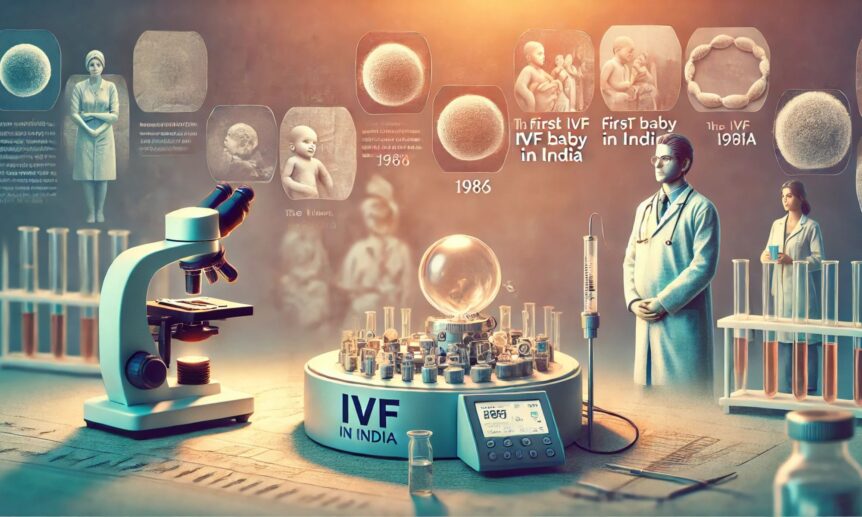
IVF in India history is marked by pioneering efforts and rapid achievements. The journey began in the early 1980s when India saw its first IVF baby born in 1986. This milestone was achieved by Dr. Subhash Mukherjee, a fertility specialist from Kolkata. His groundbreaking work gave hope to an infertile couple struggling for years to conceive naturally. This achievement played a crucial role in shaping the future of IVF in India, offering new possibilities for aspiring parents.
Dr. Mukherjee was a one of IVF specialists who brought a huge revolution in India to infertility couples or families. In Vitro Fertilization (IVF) has a long history in India, characterized by innovative work and quick developments. The first IVF baby was born in India in 1986, thanks to the efforts of Dr. Subhash Mukherjee, a fertility specialist from Kolkata, marking the beginning of the journey in the early 1980s as we discussed in the upper case of the introduction paragraph..
A significant shift in the fertility treatment landscape in India was brought about by his successful IVF treatment of a couple who had been infertile for years. Despite early skepticism and little acknowledgment, Dr. Mukherjee’s accomplishment is frequently seen as the start of the IVF revolution in India.
After this discovery, the IVF industry in India grew in the 1990s as more clinics were opened and cutting-edge reproductive technologies became accessible. IVF treatments were made available by a number of reproductive clinics and specialists throughout the nation, and India soon became Asia’s leader in assisted reproduction.
The success rates of fertility treatments were further increased as IVF technology advanced over time, introducing innovative methods like egg freezing, genetic testing, and ICSI (Intracytoplasmic Sperm Injection). Medical tourism has also increased in India, as patients seeking high-quality and reasonably priced IVF treatments travel there from the US, UK, and the Middle East.
Some of the top IVF clinics in the world are located in India today, providing cutting-edge facilities and a variety of fertility therapies at a far lower cost than in Western nations. IVF is one of the most sought-after reproductive procedures worldwide, having changed the lives of millions of couples in India.
Who Is The First Lady In India For Fertility Treatment?

Fertility Treatment in India
Mrs. Durga was the first woman in India to successfully give birth through IVF after undergoing fertility therapy. She underwent in-vitro fertilization at the KEM Hospital in Mumbai in 1978, and after giving birth to a healthy child, she became the first IVF mother in India. Under the direction of renowned fertility expert Dr. Subhash Mukherjee, the ground-breaking treatment was performed.
An important turning point in the history of assisted reproductive technology (ART) in India was reached when Mrs. Durga underwent successful IVF therapy from Dr. Mukherjee. However, because of disputes and a lack of official medical authorities’ consent, his accomplishment was not first acknowledged. Notwithstanding the difficulties, Dr. Mukherjee’s research helped India become a leader in the field of reproductive therapy and established the groundwork for contemporary IVF procedures there.
His efforts have been important in enabling IVF to be accessible to numerous couples nationwide, and his accomplishments are being honored.
Who Is The First Doctor In India? – Get Know With First IVF Specialist

IVF Specialist in India
A well-known individual in Indian medical history, Dr. Bidhan Chandra Roy, is frequently cited as the country’s first physician. He was a well-known doctor who played a key role in shaping the post-independence Indian medical and healthcare system. In addition to being a distinguished physician, Dr. Roy also served as the longtime Chief Minister of West Bengal. His contributions continue to inspire many, including every IVF specialist in India, who work to advance fertility treatments and healthcare in the country.
It is crucial to remember, though, that the earliest medical professionals in India date back thousands of years. These individuals were the doctors of the Indus Valley Civilization, who performed surgery, dentistry, and other medical procedures. Surgery, particularly cataract and plastic surgery, was discussed in ancient Indian scriptures such as the Sushruta Samhita, which is frequently referred to as the “father of surgery.”
Therefore, even if Dr. Bidhan Chandra Roy is renowned today, India’s medical practice has a long history that dates back thousands of years. We hope that you understand all things that we have expressed in the whole content. Read more articles on our official website www.worldfertilityservices.com to get latest or updated blogs.
IVF Journey and Its Growth Rate – IVF Treatment in India
Early Challenges and Disputed History
The vicious nature of IVF’s history in India stems from the doctors’ exploration for trust and recognition, with disputes largely arising in the media rather than through traditional review mechanisms.
Market growth rate and expansion of IVF
Since it was implemented, rapid growth has been observed in India, facing numerous challenges. Once India’s IVF sector developed, it has benefited several couples and become more advanced, effective, and widely available across India.
Market Cap
- The Indian IVF market in 2023 was estimated at USD 1.06 billion, with a forecast of a CAGR of 7.8% from 2024 to 2030.
- Other estimates from Grand View Research suggest that the market will reach USD 1,410.11 million in 2025 and grow at a Compound Annual Growth Rate (CAGR) of 16.23%, ultimately achieving USD 4,915.01 million by 2034.
Factors that help IVF become more popular
- The increase in infertility rates is linked to hectic work schedules, lack of physical activity, and poor dietary choices.
- Technological innovations such as picture capturing are very slow, primarily screening tests, and freezing of embryos are making IVF much positive and accessible result.
- India has positioned itself as a leading destination for the fertility sector, thanks to its budget-friendly, modern medical network, and positive rules and regulations.
Government Support
The government of India has launched drives like awareness campaigns and financial support programmes. For instance, in August 2023, the government of Goa has allowed a free IVF service at Goa Medical College and Hospital.
Statistics of Infertility
The WHO estimates that infertility affects about 1 in 6 people worldwide, or 17.5%. It is believed that the infertility rate in India falls between 3.9% and 16.8%, while AIIMS reports that 10–15% of Indian couples encounter fertility issues.
Legacy of IVF and Impact
Since 1991, India’s strategy of economic liberalisation has encouraged the adoption of technology for infertility treatment; the Indian Council of Medical Research predicts that the assisted reproduction market could reach $6 billion, according to PubMed Central. In spite of such scientific progress, the disadvantages related to infertility and cultural concerns about having children have increased the demand for infertility services.
The development of IVF in India, from Dr Mukhopadhyay’s primary work with basic tools in 1978 to the latest advanced fertility clinics across the country, explains both scientific achievement and the necessity of recognising innovative milestones, even if such acknowledgement is delayed.

Devender Gill is an experienced medical blogger & writer on the healthcare researcher with a strong focus on numerous treatments based on the official info from clinics aross network. He Specializes in creating accurate, easy-to-understand medical content covering, medical topics, for instance, IVF, Surrogacy, IUI, ICSI, and other essential ones.
Table of Contents
 WhatsApp us